
October 8, 2026 · Haulalytics Team
How Much Profit Should an Owner-Operator Make Per Mile? (2026 Numbers)
A realistic profit-per-mile target for owner-operators in 2026, the difference between take-home and true profit, and what to fix when you're only clearing 10–20 cents a mile.
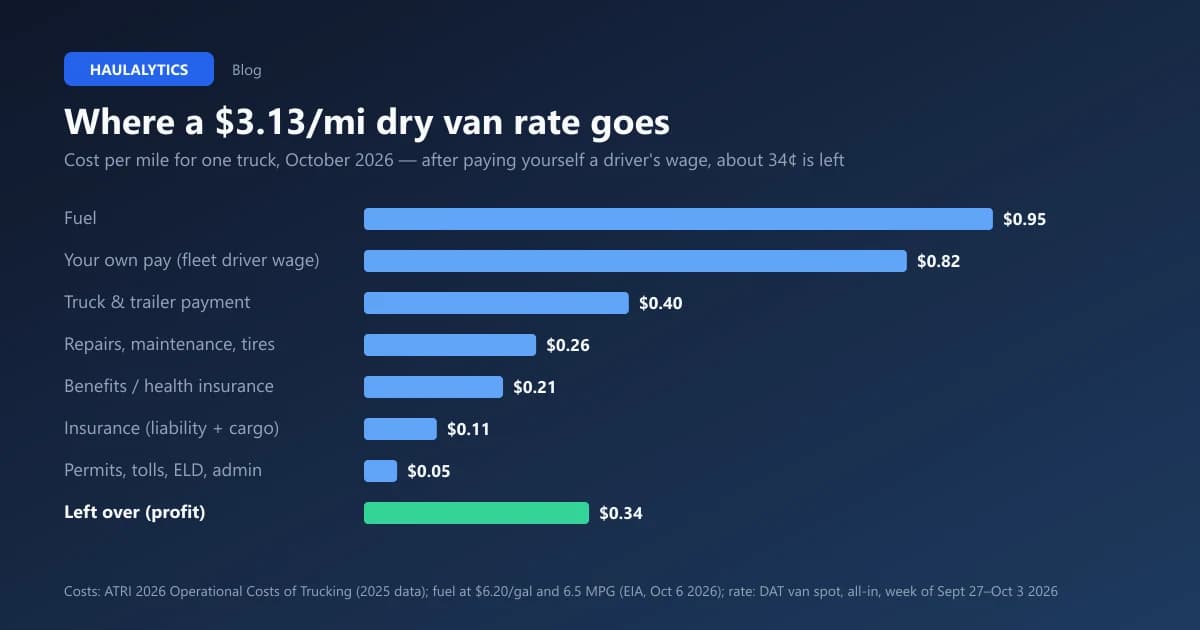
Short answer: In October 2026, an owner-operator running a dry van should expect to keep roughly $0.70–$0.85 per mile as take-home income (what ATBS calls net income, before tax, with no separate driver wage taken out), or roughly $0.30–$0.45 per mile as true profit after paying yourself a fleet driver's wage. If you are only clearing 10–20 cents a mile and that number already includes your own pay, the operation is not working. If the 10–20 cents is what's left after you and a co-driver each took a wage, you are close to the industry average and the fix is tuning, not panic.
The distinction matters because almost every "how much do owner-operators make per mile" number on the internet uses a different definition. This guide uses two numbers, says which is which, and shows where each cent of a current spot rate goes.
Key takeaways
- The national dry van spot rate was $3.13 per mile all-in (linehaul plus fuel surcharge) for the week of September 27 – October 3, 2026, per DAT. Linehaul alone was $2.25.
- The average cost to run a Class 8 truck was $2.336 per mile in 2025, and $1.854 per mile excluding fuel, per ATRI's 2026 Operational Costs of Trucking. That figure already includes a driver's wage and benefits.
- With diesel at $6.20 per gallon (EIA, October 5, 2026), fuel alone costs about $0.95 per mile at 6.5 MPG — nearly double what ATRI measured for 2025.
- The average owner-operator using ATBS's bookkeeping earned $71,808 net in 2025 on about 95,000 miles, about $0.76 per mile of take-home income.
- A 10–20 cent margin is thin enough that a single $4,000 repair wipes out a month. The fix is usually three things: deadhead, fuel economy, and the rate floor you accept.
Two numbers that get mixed up
Net income per mile is revenue minus every business expense (fuel, truck payment, insurance, maintenance, permits, tolls, factoring, bookkeeping) divided by total miles driven, including empty ones. It is what you have left to pay yourself and your taxes. This is the figure in the ATBS annual report and in most "owner-operator salary" articles.
Profit per mile is the same calculation after you have also paid yourself a market driver wage. Fleets measure it this way because they have to pay a driver whether or not the owner is in the seat. If you want to know whether owning the truck beats driving for someone else, this is the number that answers it.
| Measure | Formula | Healthy 2026 range (dry van) | | --- | --- | --- | | Net income per mile | (Revenue − business costs) ÷ total miles | $0.70 – $0.85 | | Profit per mile | Net income − a driver wage (~$0.80/mi) | $0.30 – $0.45 | | Break-even cost per mile | Business costs ÷ total miles | $1.50 – $2.40 depending on payment and fuel |
A father-and-son team that nets 10–20 cents a mile after both draw a wage is, on paper, inside the normal range for a first month. A solo operator whose 10–20 cents is the whole take-home is working for less than a company driver's $0.55–$0.65 per mile and carrying all the risk.
Where a $3.13 rate actually goes
Here is the same math for one dry van tractor in October 2026, using ATRI's per-mile cost lines and today's diesel price. Round numbers, one truck, 9,000 miles a month.
| Cost line | Per mile | Where the number comes from | | --- | --- | --- | | Fuel (6.5 MPG, $6.20/gal) | $0.95 | EIA weekly average, Oct 5, 2026 | | Driver wage (your own pay) | $0.82 | ATRI 2025 average driver wages | | Driver benefits / health insurance | $0.21 | ATRI 2025 | | Truck and trailer payment | $0.40 | ATRI 2025, a record high | | Repairs, maintenance, tires | $0.26 | ATRI 2025 ($0.215 R&M, tires separate) | | Liability and cargo insurance | $0.11 | ATRI 2025; new authorities pay more | | Permits, tolls, ELD, admin | $0.05 | ATRI 2025 | | Total cost | $2.80 | | | Spot rate, all-in | $3.13 | DAT, week of Sep 27 – Oct 3, 2026 | | Profit after paying yourself | $0.34 | | | Net income (profit + wage + benefits) | $1.37 | |
Two things stand out. First, the single largest line is now fuel, not the driver, which was not true when ATRI collected 2025 data. Second, the profit line is a leftover: every cent of deadhead, every extra day at a shipper, every gallon of idling comes straight out of that $0.34.
Owner-operators who skip the benefits line (no health insurance) and run a paid-off truck can show $0.75 or more. Operators with a new-authority insurance premium of $1,500 a month and a $2,800 truck payment can show nothing at all at the same rate.
Why the first month looks worse than it is
A new operation almost always under-earns its real run rate for four reasons:
- Deadhead is highest at the start. Without lane knowledge, 25–30% empty miles is common. At $3.13 loaded, 25% deadhead cuts the revenue per total mile to about $2.35. The industry norm is 15–20%, and disciplined operators run under 12%. See how to reduce deadhead miles.
- Start-up costs land in month one. Plates, the 2290 tax, the insurance down payment, an ELD, a trailer deposit. Spread over a year they are a few cents a mile; charged to one month they look like a disaster.
- Fuel is at a record. Diesel averaged $5.01 for 2026 through September and hit $6.53 on September 21. If your plan used $4.00, you are paying $0.30–$0.40 per mile more than you budgeted.
- New-authority rates are lower. Many brokers pay less to carriers with under 90 days of authority, and the best contract lanes are not open yet.
None of these are permanent. Track them separately so you can see which one is costing you the most.
Fixed versus variable: what you can change this month
Fixed costs (payment, insurance, permits, software) do not move when you park the truck; variable costs (fuel, tires, maintenance, tolls) scale with miles. The split decides your strategy:
- If fixed costs are high (new truck, new-authority insurance), the only lever is miles. Every loaded mile spreads the same fixed dollars thinner. Running 7,000 miles instead of 9,000 adds about $0.15 per mile of fixed cost at a $4,200 monthly fixed base.
- If variable costs are high (fuel, an older truck), the lever is efficiency. One mile per gallon is worth about $0.13 per mile at $6.20 diesel (6.0 vs 7.0 MPG). On 9,000 miles that is $1,170 a month.
Our cost-per-mile guide walks through the full breakdown; the break-even calculator article shows how to turn it into a rate floor.
The fuel surcharge is not covering fuel
Most broker surcharges use a formula like (diesel price − $1.25 base) ÷ 6 MPG. At $6.20 that pays about $0.83 per mile. A truck getting 6.5 MPG burns about $0.95. The surcharge was designed when 6 MPG and a $1.25 base were reasonable; in 2026 it leaves 10–15 cents a mile uncovered before any other cost. When you negotiate, ask what base and MPG the surcharge assumes, and treat the gap as part of your linehaul floor. How fuel surcharges work covers the formulas.
A practical target for 2026
Set the floor as a rate per total mile, not per loaded mile:
- Add up last month's business costs (not your pay). Divide by total miles driven. That is your break-even.
- Add the wage you need to live on, per mile. For most solo operators that is $0.60–$0.80.
- Add the profit you want the business to keep: $0.25–$0.40 per mile covers a repair fund and a down payment on the next truck.
For a typical 2026 operation that lands between $2.60 and $3.20 per total mile, all-in. Loads that pay less than the first two lines are a loss. Loads between the second and third line are acceptable to reposition. Rate every load against that number before you accept it — the Haulalytics calculator does the per-mile math with live diesel prices and truck-rated tolls so the floor is visible before you call the broker back.
When 10–20 cents means stop
Cutting losses is the right call when all three are true: the margin is 10–20 cents including your wage, the truck has a payment, and you have no cash reserve. In that case every breakdown is financed at credit-card rates, and the math gets worse each month. The emergency fund guide explains how much cushion a one-truck operation needs.
If instead the margin is thin but you are paid-up on the truck, cash-positive, and in month one, give it ninety days with deadhead, MPG, and the rate floor tracked weekly. Most operators who survive the first quarter double their margin by the second simply by refusing the loads they took in month one.
FAQ
What is a good profit per mile for an owner-operator in 2026?
After all business expenses, a well-run dry van operation keeps $0.70–$0.85 per mile as take-home income, or $0.30–$0.45 per mile as true profit once a fleet-driver wage of about $0.80 per mile is subtracted. The ATBS average for 2025 was $71,808 net on about 95,000 miles, roughly $0.76 per mile.
Is 10 to 20 cents profit per mile too low?
It depends on what the number includes. If 10–20 cents is left after you have paid yourself a wage, that is near the industry average for a new operation. If 10–20 cents is your entire take-home per mile, you are earning less than a company driver while carrying all the risk, and something — usually deadhead, fuel economy, or the rates you accept — needs to change.
What does it cost to run a semi truck per mile in 2026?
ATRI measured an average of $2.336 per mile for 2025, including a driver's wage and benefits, and $1.854 per mile excluding fuel. With diesel at $6.20 per gallon in October 2026, fuel alone adds about $0.95 per mile at 6.5 MPG, so a realistic 2026 total is $2.70–$2.90 per mile for a truck with a payment.
How do I calculate my own profit per mile?
Add every business expense for the month, including fuel, payment, insurance, maintenance, permits, tolls and fees. Subtract that total from revenue, then divide by every mile driven including deadhead. That is net income per mile. Subtract a driver wage of $0.60–$0.80 per mile to see the profit the business itself makes.
Does the fuel surcharge cover fuel at $6 diesel?
Usually not. A common formula, (diesel price − $1.25) ÷ 6 MPG, pays about $0.83 per mile at $6.20 diesel, while a truck at 6.5 MPG burns about $0.95. The 10–15 cent gap should be treated as part of your linehaul rate floor.