
October 8, 2026 · Haulalytics Team
Best Semi-Truck for a New Owner-Operator in 2026: Cascadia vs 579 vs T680 vs VNL
Which first truck experienced owner-operators actually recommend in 2026, what a 3–4-year-old sleeper costs, Cummins vs Detroit vs PACCAR, and the inspection checklist that keeps you from buying someone else's problems.
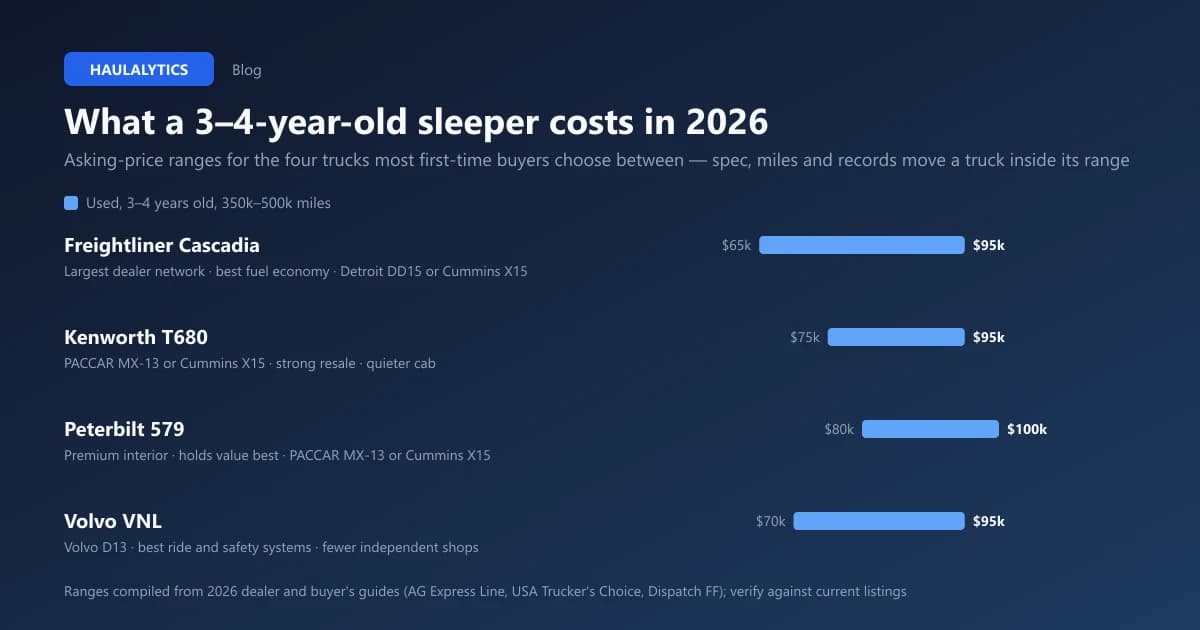
Short answer: For a first truck in 2026, most experienced owner-operators point to a 3–4-year-old Freightliner Cascadia or Kenworth T680 with 350,000–500,000 miles and complete service records, bought for $65,000–$95,000, rather than a new truck at $155,000–$210,000. The Cascadia wins on purchase price, fuel economy and the number of shops that can fix it; the T680 and Peterbilt 579 hold their value better and ride quieter; the Volvo VNL has the best cab and safety systems but fewer independent shops. The brand matters less than the engine's paperwork: an ECM pull, DPF regen history and a blow-by test tell you more than the badge.
This guide is for someone who has decided to buy and wants to know what to buy, what it costs in October 2026, and how not to get burned.
Key takeaways
- A truck payment averaged $0.404 per mile in 2025, a record, according to ATRI. A $90,000 used truck financed over five years at 9% is about $1,870 a month — $0.21 per mile at 9,000 miles. A $180,000 new truck is double that.
- Repairs and maintenance ran $0.215 per mile in 2025, up 8.6% in a year, plus tires. Budget $0.25–$0.30 per mile for a used truck.
- With diesel at $6.20 a gallon, one MPG is worth about $0.13 per mile — $1,100 a month. Fuel economy is the biggest difference between models.
- Emissions equipment (DPF, SCR, EGR) is where used trucks fail expensively. A truck with a deleted DPF is illegal interstate and can fail inspection; a truck with a neglected one is a $5,000–$15,000 bill waiting to happen.
- Buy the truck with the dealer network that covers your lanes. A breakdown 600 miles from the nearest authorized shop costs more than any price difference.
What veterans actually recommend
Ask a room of owner-operators what their first truck was and you will hear a lot of used Cascadias, a fair number of Volvos, and a few people who bought a new Peterbilt and spent two years regretting the payment. The pattern in their advice:
- Buy used, three to five years old. The first owner absorbed the steepest depreciation; the truck still has 500,000 miles of life if it was maintained.
- Buy from a fleet with records, not from an individual with a story. Fleet trade-ins from a lease program come with oil-change intervals and warranty work documented. Pay for an independent inspection either way.
- Buy the engine the shops near you know. Cummins parts are on every shelf; Detroit requires a Freightliner or Western Star dealer for software; PACCAR MX engines have a smaller independent network.
- Do not spec for the truck you want in five years. A 72-inch raised-roof sleeper with a 600-hp engine is a lifestyle, not a business. A mid-roof with a 450–500 hp engine on a 2.26–2.47 rear ratio is what fleets buy, because it pays.
- Keep $10,000 in reserve after the purchase. The first big repair arrives in the first six months more often than not.
The four trucks, compared
| Truck | Engines | Why first-timers buy it | Watch for | 3–4-yr-old asking price, 2026 | | --- | --- | --- | --- | --- | | Freightliner Cascadia | Detroit DD13/DD15, Cummins X15 | Best fuel economy (fleet-spec DD15 + DT12 runs 7.5–8.5 MPG), biggest dealer network, lowest price per truck | DD15 software needs a dealer; interior wears faster than the others | $65,000–$95,000 | | Kenworth T680 | PACCAR MX-13, Cummins X15 | Quiet cab, strong resale, good ride; the X15 option is what most owner-operators want | PACCAR MX-13 aftertreatment issues on 2017–2019 units; fewer MX-capable independents | $75,000–$95,000 | | Peterbilt 579 | PACCAR MX-13, Cummins X15 | Premium interior, holds value best of the four | Priced at a premium that the freight does not know about | $80,000–$100,000 | | Volvo VNL | Volvo D13 | Best ride and driver-assist systems, I-Shift transmission is excellent | D13 and I-Shift require Volvo dealers; parts and software are proprietary | $70,000–$95,000 |
Price ranges compiled from 2026 dealer and buyer's guides (AG Express Line, USA Trucker's Choice, Dispatch FF) for 2022–2023 sleepers with roughly 350,000–500,000 miles. A specific truck moves inside its range on spec, mileage, warranty remaining and records. New trucks from the same four brands are $155,000–$210,000 before financing.
The Mack Anthem and International LT are worth a look if the price is right — both are $10,000–$20,000 cheaper used — but resale is weaker and the dealer networks are thinner in the West.
Cummins X15 vs Detroit DD15 vs PACCAR MX-13
There is no independent failure-rate data that separates these engines; what follows is the consensus from shops and long-term owners.
Cummins X15 is the owner-operator default because any shop can work on it, parts are everywhere, and a well-kept one runs 900,000–1.2 million miles before an in-frame. It is available in the Cascadia, T680 and 579, which is why it commands $3,000–$8,000 more on the used market than the same truck with the house engine. Fuel economy is a few tenths of a mile per gallon behind the DD15.
Detroit DD15 (Cascadia) is the fuel-economy engine. The 2013-and-later SCR-era engines are reliable and typically go 800,000–1,000,000 miles before major work; the 2008–2010 EGR-only generation is the one to avoid. Diagnostics and software require a Detroit dealer, which is fine on I-80 and a problem in rural Montana. Known weak points at high mileage: the asymmetric turbo actuator and the parent-bore block, which is expensive at full rebuild.
PACCAR MX-13 (T680, 579) improved a lot after 2020, but 2017–2019 engines have a documented history of aftertreatment and EGR problems. If you are looking at a PACCAR-powered Kenworth or Peterbilt from those years, the regen history matters more than anything else on the truck.
Volvo D13 is a good engine inside a closed ecosystem: the I-Shift, the engine and the truck's electronics are all Volvo, and Volvo's dealers are the ones who can read them.
The honest summary: maintenance history beats brand. A neglected X15 with 600,000 miles and no records is a worse buy than a DD15 with 850,000 miles and full dealer history.
New vs used in the 2026 market
| | New (2026 model) | 3–4 years old | 6–8 years old | | --- | --- | --- | --- | | Price | $155,000–$210,000 | $65,000–$100,000 | $35,000–$55,000 | | Monthly payment (5 yr, 9%, 15% down) | $2,700–$3,700 | $1,150–$1,750 | $600–$1,000 | | Payment per mile at 9,000 mi/mo | $0.30–$0.41 | $0.13–$0.19 | $0.07–$0.11 | | Repair reserve per mile | $0.10 (under warranty) | $0.25 | $0.35+ | | Typical fuel economy | 7.5–8.5 MPG | 7.0–8.0 | 6.0–7.0 | | Risk | Payment survives a slow quarter? | Out-of-warranty repairs | Downtime, emissions failures |
At current rates — DAT's dry van spot average was $3.13 all-in in early October 2026 — a new truck's payment eats most of the margin our profit-per-mile guide shows is available. A 3–4-year-old truck costs $0.10–$0.20 per mile more in repairs and fuel than a new one and $0.15–$0.25 per mile less in payment; the used truck wins on cash flow and loses only if it spends weeks in the shop. The older truck is the gamble: cheap on paper, but every month of downtime is $8,000–$10,000 of lost revenue with the fixed costs still due. Leasing vs buying covers the financing side.
The used-truck inspection checklist
Never buy without these, in this order. Walk away from any seller who refuses one.
- ECM report. Pull the engine computer: total miles and hours, idle percentage, fault history, derate events. Compare miles to the odometer and hours to miles (over 25% idle time is a truck that spent its life in a yard or a sleeper line). A seller who will not allow the pull has answered your question.
- Aftertreatment history. Regen count and frequency, soot load, DEF consumption, any DPF cleaning or replacement invoices. More than one active regen a day is a red flag; DPF cleaning should be on record every 150,000–200,000 miles. Check physically that the DPF is present and ask in writing whether any emissions equipment has ever been modified.
- Blow-by and, if you can afford it, a dyno run. Blow-by measurement is the single best predictor of whether the engine will make it to the next in-frame. $300–$600 at an independent shop.
- Oil analysis. Coolant or fuel in the oil shows up here before it shows up as a failure.
- Service records. Oil-change intervals, valve adjustments (at 100,000–150,000 mile intervals on most engines), clutch or transmission service, any warranty work. Gaps longer than 30,000 miles are gaps for a reason.
- Frame, fifth wheel, air system, brakes, tires. Measure brake lining and tire tread yourself; a set of eight drive tires is $3,500–$5,000 in 2026.
- Title, lien and VIN check. Confirm the seller can transfer clear title and that the VIN on the door, frame and title match.
- Warranty. Many 3–4-year-old trucks are still inside an extended engine/aftertreatment warranty (often 5 years / 500,000–600,000 miles). Confirm it transfers.
Budget $800–$1,500 for the inspections. It is the cheapest $1,500 you will spend on the truck.
Where to buy
- Fleet-trade dealers (Freightliner's SelecTrucks, Kenworth and Peterbilt certified pre-owned, Volvo Selected) sell inspected trucks with limited warranties at a $5,000–$10,000 premium over private sales. For a first truck, the premium is usually worth it.
- Auction (Ritchie Bros., IronPlanet) is cheapest and riskiest; you inspect in a yard, not on a dyno.
- Private sellers and TruckPaper listings fall in between. Insist on the full checklist.
FAQ
What is the best first truck for a new owner-operator in 2026?
A 3–4-year-old Freightliner Cascadia or Kenworth T680 with 350,000–500,000 miles, complete service records and a Cummins X15 or Detroit DD15, bought for $65,000–$95,000. These have the lowest cost per mile to own and the widest repair network. The Peterbilt 579 and Volvo VNL are excellent trucks that cost more to buy and, in Volvo's case, are harder to get serviced outside the dealer network.
Should a new owner-operator buy a new or used semi truck?
Used. A new truck's $2,700–$3,700 monthly payment is $0.30–$0.41 per mile at 9,000 miles, which at current spot rates consumes most of the available profit. A 3–4-year-old truck costs roughly half as much to finance and $0.10–$0.20 per mile more in repairs and fuel, and comes out ahead on cash flow unless it has major downtime.
Cummins X15 or Detroit DD15 for an owner-operator?
Cummins X15 if you value being able to get the truck fixed anywhere; Detroit DD15 if fuel economy matters more and you run lanes with Freightliner dealers. Both reach 800,000–1,200,000 miles with good maintenance. Service history is a better predictor than the brand.
How much does a used semi truck cost in 2026?
A 3–4-year-old sleeper from Freightliner, Kenworth, Peterbilt or Volvo lists for about $65,000–$100,000 depending on spec, miles and warranty. Six-to-eight-year-old trucks sell for $35,000–$55,000; new sleepers from the same brands are $155,000–$210,000.
What should I check before buying a used semi truck?
Get an ECM report (miles, hours, idle time, fault history), the DPF and regen history, a blow-by measurement or dyno run, an oil analysis, complete service records with valve-adjustment and DPF-cleaning intervals, a brake and tire measurement, a clear-title and VIN check, and confirmation that any remaining warranty transfers. Walk away if the seller refuses the ECM pull.