
October 8, 2026 · Haulalytics Team
How to Find Trucking Loads and Rates Before You Start a Company (No MC Number Needed)
Where to see real freight rates for cargo vans, box trucks and semis before you have an MC number or a load-board subscription, and how to turn those rates into a profitability estimate for each equipment type.
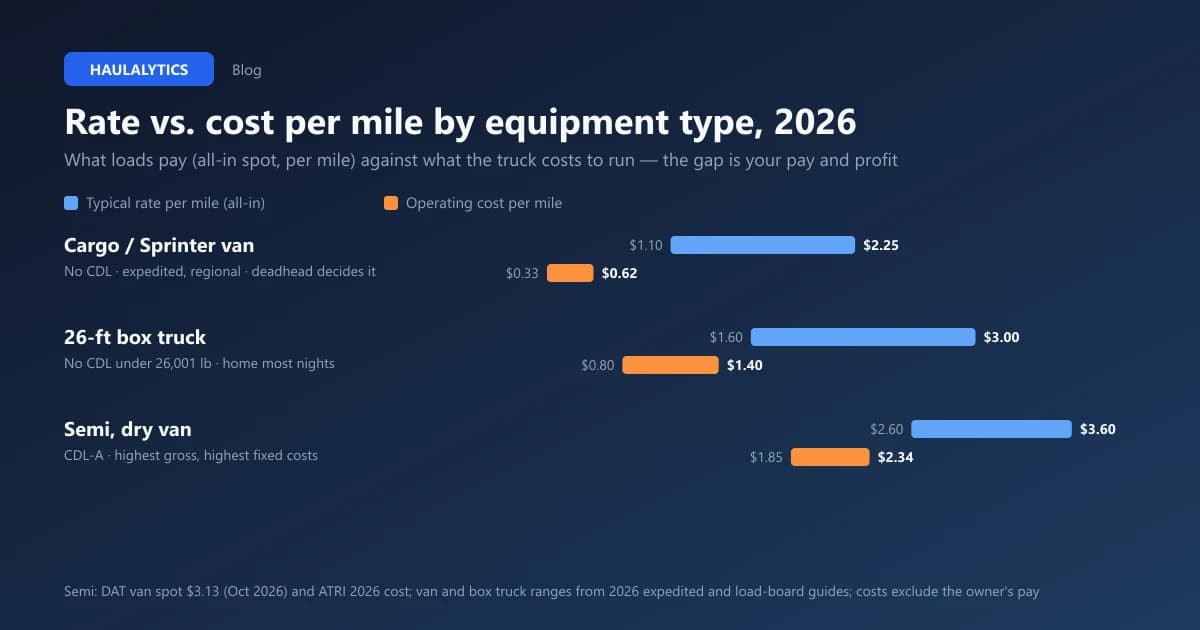
Short answer: You do not need an MC number or a DAT subscription to find out what freight pays. DAT publishes its national average spot rates every week for free; free load boards such as 123Loadboard, TruckSmarter and the large brokers' own carrier portals show posted loads with rates; and the per-mile rate ranges for each equipment type are stable enough in 2026 to estimate a business with. As of early October 2026 the national dry van spot average is $3.13 per mile all-in, box trucks post at roughly $1.60–$3.00, and cargo vans at $1.10–$2.25. What decides profitability is not the rate — it is the rate minus your cost per mile, times how many of your miles are loaded.
This guide shows where to get the numbers, how to read them, and how to compare a cargo van, a box truck and a semi on the same basis before you spend anything.
Key takeaways
- Spot rates are quoted two ways: linehaul (fuel excluded) and all-in (linehaul plus fuel surcharge). DAT's dry van rate for the week of September 27 – October 3, 2026 was $2.25 linehaul and $3.13 all-in. Mixing the two is the most common mistake in a startup plan.
- A load board rate is what the broker posts, before negotiation and before deadhead. Your revenue per total mile is usually 15–25% lower.
- Cargo vans and box trucks under 26,001 lb need no CDL, but for-hire interstate work still requires a USDOT number and, above 10,001 lb GVWR, operating authority and the same $750,000 minimum liability as a semi.
- Semis gross the most and cost the most. In 2026 a semi's operating cost is $1.85–$2.34 per mile; a box truck's is $0.80–$1.40; a cargo van's is $0.33–$0.62. Net per mile is much closer than the gross rates suggest.
Where to see real rates without an MC number
1. DAT's free weekly reports
DAT publishes a Trucking Market Update, a Dry Van Report, a Reefer Report and a Flatbed Report every week with national average spot linehaul and all-in rates, load-to-truck ratios and a 35-day forecast. These are the same numbers the trade press quotes and they cost nothing. DAT Trendlines (also free) shows the monthly series by equipment type, and the DAT One app can be opened without a subscription to see posted loads' origins and destinations, though rates are gated. What you cannot get for free is lane-level rates — that is the $49–$259 a month subscription.
2. Free load boards
| Board | Free tier | What you can see | Needs authority to view? | | --- | --- | --- | --- | | 123Loadboard | Yes, usable | Loads with rates, limited filters | No (yes to book) | | TruckSmarter | Yes, no card | Loads with rates, fuel discounts | No (yes to book) | | C.H. Robinson Navisphere Carrier | Yes | CHR's own loads with rates | Yes to register | | Truckstop | 7-day trial on paid tiers | Loads, rates, broker credit | Yes | | DAT One | View only | Posted lanes; rates gated | No to view, yes to book |
Spend a week looking at loads out of your home area on two of these. Write down origin, destination, miles, rate and equipment for fifty loads. That sample tells you more about your lanes than any national average.
3. Broker rate confirmations and dispatchers
If you know anyone running, ask to see thirty days of their rate confirmations — the actual signed rate, the miles the broker paid on, and the surcharge. A dispatch service will also tell you what they are booking for similar equipment, because they want your business. How to read a rate confirmation explains what each line means.
4. The federal and public data
- The EIA publishes the national diesel price every Monday; it was $6.199 a gallon on October 5, 2026, the second-highest weekly price on record after $6.529 on September 21.
- ATRI's Operational Costs of Trucking gives the per-mile cost lines for a Class 8 truck: $2.336 total and $1.854 excluding fuel in 2025.
- FMCSA's SAFER system lets you look up any carrier's fleet size, inspection and crash history for free — useful for checking the brokers and carriers you are about to deal with.
Rates and costs by equipment type, 2026
The table uses all-in spot rates (fuel included) for the typical freight each vehicle runs, and operating cost per mile excluding the owner's own pay. Ranges come from DAT (semi), ATRI (semi cost), and 2026 expedited-freight and load-board guides (van and box truck).
| Equipment | Typical all-in rate / mi | Operating cost / mi | Typical weekly miles | Needs CDL | Startup cost (used equipment) | | --- | --- | --- | --- | --- | --- | | Cargo / Sprinter van | $1.10–$2.25 | $0.33–$0.62 | 2,000–3,500 | No | $15,000–$40,000 | | 26-ft box truck (under 26,001 lb) | $1.60–$3.00 | $0.80–$1.40 | 1,500–2,500 | No | $30,000–$70,000 | | Semi, dry van (53 ft) | $2.60–$3.60 (avg $3.13) | $1.85–$2.34 | 2,000–3,000 | CDL-A | $60,000–$120,000 plus trailer |
Three things the table does not show:
- Expedited van and box freight pays by the load, not the mile. A 300-mile same-day run at $650 is $2.17 a mile; the 300 empty miles home make it $1.08. Cargo-van operators who keep deadhead under 25% are profitable; those who do not are break-even at best.
- Semi rates include a fuel surcharge; van and box rates often do not. At $6.20 diesel that is the difference between a rate that moves with fuel and one that does not.
- Box trucks and vans compete with couriers and with each other. There is more capacity than freight in most metros in 2026; the rates at the top of the ranges are for dedicated or expedited work you have to earn.
Turning a rate into a profit estimate
Do this for each equipment type before you buy anything. The arithmetic is the same; only the numbers change. Cost per mile explained has the full worksheet.
Step 1 — cost per mile. Add monthly fixed costs (payment, insurance, plates, permits, phone, software) and divide by expected monthly miles. Add variable costs per mile (fuel at the current diesel price divided by your MPG, maintenance, tires, tolls). For a 2026 dry van semi with a $1,500 payment and new-authority insurance that comes to about $2.30–$2.60 per mile at 9,000 miles.
Step 2 — revenue per total mile. Take the rate you expect to book, then multiply by (1 − deadhead share). At $3.13 and 20% deadhead, revenue per total mile is $2.50.
Step 3 — margin. Revenue per total mile minus cost per mile. In this example, $2.50 − $2.45 = $0.05 per mile before paying yourself. That is why a semi at a new authority's cost structure looks worse on paper than a box truck that nets $0.60 a mile — and why the semi still wins for operators who get deadhead under 12%, buy a truck with a smaller payment, and negotiate above the average.
Step 4 — monthly reality. Multiply margin by monthly miles, then subtract the wage you need. If the result is negative at the rates you can actually book, the business does not work at that equipment and cost level, and no amount of hustle changes the arithmetic.
The Haulalytics calculator does steps 1–3 for a semi with live diesel prices, truck-routed miles and tolls; the profitability guide shows the same math by hand.
Which equipment makes sense in 2026
- Cargo van: lowest risk and lowest ceiling. Realistic net income for a solo operator with low deadhead is $45,000–$70,000 a year. Good for testing whether you want to be in freight at all, and the only option without a CDL or the capital for a box truck.
- Box truck: the best regional, home-most-nights business in the group when you can find dedicated or expedited work. Net $40,000–$100,000 depending on lanes and deadhead. Watch the 26,001 lb line: above it you need a CDL-B and the costs of a Class 7 truck.
- Semi: highest gross ($150,000–$300,000 a year), highest fixed costs, and the only one that benefits from the 2026 spot market, which is up more than 30% year over year for dry van. Net $50,000–$120,000 for a solo operator; the spread is deadhead, fuel economy and the truck payment. Our profit-per-mile guide breaks down a $3.13 rate line by line.
What to do this week
- Pull DAT's current weekly reports for van, reefer and flatbed and note the linehaul and all-in averages.
- Sign up for 123Loadboard's or TruckSmarter's free tier and log fifty loads out of your area for the equipment you are considering.
- Build a cost per mile for each equipment type with today's diesel price, a real insurance quote (not a guess) and the actual payment on a truck you have priced.
- Compare revenue per total mile to cost per mile at 15%, 20% and 25% deadhead.
- Only then decide on equipment, and read how to start as an owner-operator for the licensing and insurance steps.
FAQ
Can I see load board rates without an MC number?
Yes. DAT publishes national average spot rates weekly for free, 123Loadboard and TruckSmarter show posted loads with rates on free tiers, and large brokers' carrier portals list their own loads. Booking a load requires authority; seeing what loads pay does not.
What are trucking rates per mile in 2026?
As of early October 2026, DAT's national dry van spot average is $3.13 per mile all-in ($2.25 linehaul before fuel surcharge), reefer about $3.69 and flatbed about $3.71. Box trucks typically post at $1.60–$3.00 per mile and cargo vans at $1.10–$2.25, usually without a separate fuel surcharge.
Is a cargo van, box truck or semi more profitable?
A semi grosses the most ($150,000–$300,000 a year) and costs the most to run ($1.85–$2.34 per mile); a box truck nets $40,000–$100,000 on regional work; a cargo van nets $45,000–$70,000 for a solo operator with low deadhead. Net income per mile is closer than gross rates suggest, and deadhead decides it for the smaller vehicles.
Do I need an MC number for a cargo van or box truck?
For-hire interstate work in a vehicle over 10,001 lb GVWR requires a USDOT number, operating authority and $750,000 minimum liability, the same as a semi. Most cargo vans are under 10,001 lb and are exempt from authority (but not from a USDOT number if they cross state lines for hire); nearly all box trucks are above it. No CDL is required under 26,001 lb.
What is the difference between linehaul and all-in rates?
Linehaul is the rate for the haul itself; all-in adds the fuel surcharge. DAT reports both: in early October 2026 the dry van linehaul was $2.25 and the all-in rate $3.13. Compare linehaul to your non-fuel cost per mile and all-in to your total cost per mile, never one to the other.