
October 8, 2026 · Haulalytics Team
Is Becoming an Owner-Operator Worth It With Diesel at $6? (October 2026)
Owner-operator vs company driver in 2026: what record diesel does to the math, how much capital it takes to start, the fuel-surcharge gap, and a decision checklist for anyone thinking about buying a truck again.
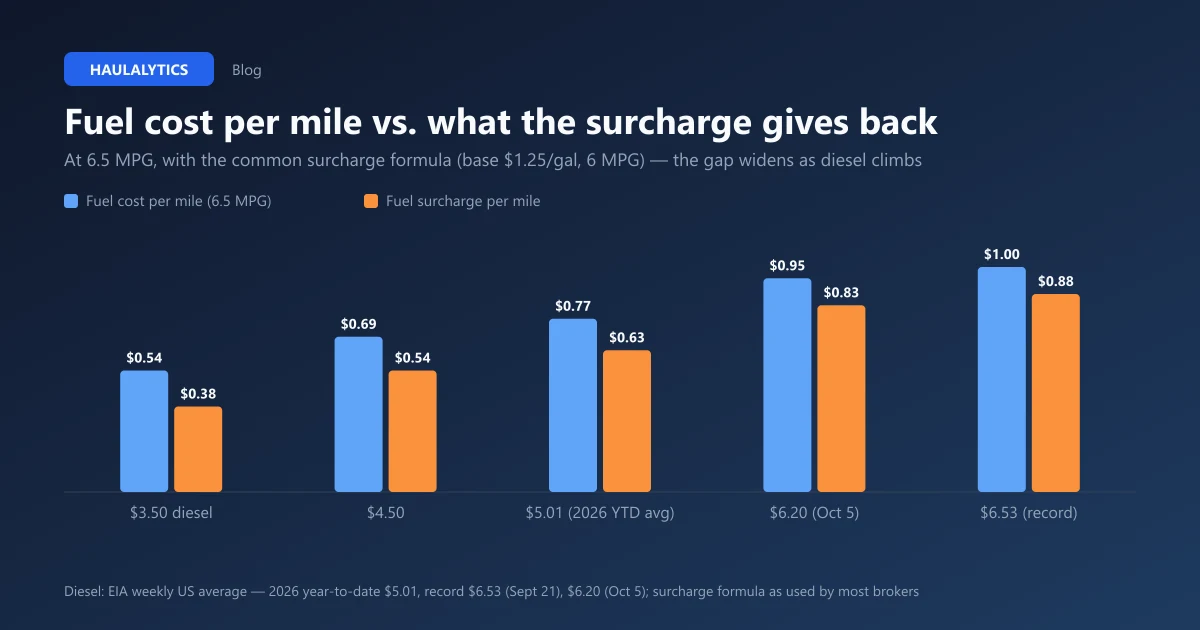
Short answer: It can be, but not for the reason most people get back in. Diesel averaged $6.199 a gallon on October 5, 2026 (EIA), down from a record $6.529 on September 21 and about $2.50 higher than a year earlier. At those prices fuel costs a 6.5-MPG truck about $0.95 per mile while the standard fuel surcharge returns about $0.83, so every loaded mile leaks 10–15 cents before any other cost. What makes 2026 workable is that spot rates are the best since 2022 — DAT's dry van rate is $3.13 all-in, up 32% year over year — and the surcharge, imperfect as it is, moves with fuel. An owner-operator who runs under 15% deadhead, keeps MPG above 7, and starts with enough cash to survive the fuel bill comes out ahead of a company driver's $58,000–$68,000. One who gets back in with a thin reserve and a 6-MPG truck does not.
This article is for the driver who has owned before, went back to a company seat, and is wondering whether the current market is worth another try.
Key takeaways
- Diesel is the highest it has ever been, and the cause is refining capacity and distillate exports, not crude. The EIA expects prices above $6 through October and "unusually tight" inventories into early 2027. Plan on $5.50–$6.50, not $4.
- The surcharge gap is structural. Most brokers' formulas assume 6 MPG and a $1.25 base; the gap to real fuel cost grows as diesel rises and shrinks only if your MPG beats the formula's.
- Owner-operators averaged $71,808 net in 2025 per ATBS, versus a BLS median of $58,640 for employed heavy-truck drivers — but that $71,808 is before self-employment tax, health insurance and the truck's replacement.
- Startup capital in 2026 is $20,000–$40,000 cash on top of the truck's down payment: first-year insurance, plates, 2290, a trailer deposit, and six weeks of $6 diesel before the first broker pays.
- The decision turns on four numbers you can calculate before you buy anything: your MPG, your deadhead, your cost per mile, and your reserve.
What is happening to diesel, and for how long
For most of 2025 diesel sat near $3.60. In 2026 the United States has produced record crude — about 13.8 million barrels a day — and still run short of diesel, because refineries have been at 97% utilization with no spare capacity to add distillate output, while exports to a global market disrupted in the Middle East and Russia have stayed at five-year highs. U.S. distillate inventories fell below 100 million barrels in September, under the five-year range, and the Gulf Coast diesel crack spread passed $100 a barrel on September 1, five times its pre-conflict level.
The EIA's October outlook says retail diesel will stay above $6 in October and then ease gradually with crude and a slight inventory recovery, but that inventories will remain tight into early 2027. For planning purposes: a $5.50 floor for the next two quarters, with spikes back toward $6.50 if anything else goes wrong. The diesel fuel cost crisis page tracks the weekly number.
Fuel per mile vs what the surcharge gives back
| Diesel price | Fuel cost / mi at 6.5 MPG | Fuel cost / mi at 7.5 MPG | Surcharge / mi (base $1.25, 6 MPG) | Gap at 6.5 MPG | | --- | --- | --- | --- | --- | | $3.50 | $0.54 | $0.47 | $0.38 | $0.16 | | $4.50 | $0.69 | $0.60 | $0.54 | $0.15 | | $5.01 (2026 YTD average) | $0.77 | $0.67 | $0.63 | $0.14 | | $6.20 (Oct 5, 2026) | $0.95 | $0.83 | $0.83 | $0.12 | | $6.53 (record, Sep 21) | $1.00 | $0.87 | $0.88 | $0.12 |
Two conclusions. First, the surcharge formula has a built-in gap at every price, so negotiate the linehaul to cover it rather than hoping the surcharge will. Second, a truck that gets 7.5 MPG instead of 6.5 is worth about $0.12 per mile at current prices — $1,100 a month, or roughly the entire gap. The cheapest hedge against $6 diesel is a truck spec'd and driven for fuel economy: 62–65 mph, a direct-drive automated transmission, skirted trailer, and a driver who does not idle. The true cost of idling has the numbers for that last one.
Owner-operator vs company driver, 2026
| | Company driver | Owner-operator (dry van, own authority) | | --- | --- | --- | | Gross revenue | n/a | $220,000–$300,000 at 95,000–110,000 mi | | Pay / net income | $55,000–$75,000 (BLS median $58,640; top carriers $72,000–$86,000 for 5+ yrs) | $71,808 average (ATBS 2025); $87,614 for ATBS's best-run clients | | Benefits | Health insurance, 401(k) match, paid time off | Buy your own: $600–$1,200 a month for a family plan | | Taxes | Withheld | Self-employment tax of 15.3% on net earnings, quarterly estimates | | Fuel risk | None | All of it, minus the surcharge | | Breakdown risk | None | $14,222 average maintenance spend in 2025 (ATBS); one failure can be $15,000 | | Capital at risk | $0 | $15,000–$40,000 down payment plus $20,000–$40,000 working capital | | Control | Dispatch decides | You decide lanes, home time, equipment |
Put the numbers side by side and the honest comparison is: an average owner-operator earns $10,000–$15,000 more than a good company driver, before buying health insurance and funding the next truck, and carries all of the fuel and repair risk. Owner-operators in the top quarter earn $90,000–$120,000 and the comparison is not close. The question is which group you were in last time, and what changed.
What it costs to get back in, October 2026
| Item | One-time | Monthly | | --- | --- | --- | | Used truck, 3–4 years old ($65,000–$95,000), 15% down | $10,000–$15,000 | $1,150–$1,750 | | New-authority insurance (year one $14,000–$25,000), 20% down | $3,000–$5,000 | $1,200–$2,000 | | IRP plates, 2290, UCR, BOC-3, authority filing | $2,500–$4,500 | | | Rented dry van trailer | $1,000–$2,000 deposit | $750–$1,200 | | ELD, software, Clearinghouse consortium | $300–$500 | $50–$100 | | Fuel float: 6 weeks before brokers pay, 9,000 mi/mo at $0.95 | $12,000–$13,000 | | | Reserve for the first repair | $10,000 | | | Cash needed beyond the truck payment | $39,000–$50,000 | $3,150–$5,050 fixed |
Factoring reduces the fuel float to about ten days at a cost of 2–4% of revenue — $5,000–$10,000 a year — which is often the right trade for a restart. How to get your own authority breaks down the filings; the startup guide covers the rest. Leasing on to a carrier cuts the insurance line to $45–$500 a month and removes the trailer and authority costs, in exchange for 20–30% of the rate and the carrier's lanes.
Two restarts, same market
Both operators book the DAT average of $3.13 all-in and run 9,000 miles a month. Costs use ATRI's 2025 lines with October 2026 fuel.
| | Operator A | Operator B | | --- | --- | --- | | Truck | 2022 Cascadia DD15, 7.6 MPG, $1,500/mo | 2017 579 X15, 6.2 MPG, paid off | | Deadhead | 11% | 22% | | Revenue per total mile | $2.79 | $2.44 | | Fuel per mile | $0.82 | $1.00 | | Payment, insurance, plates, permits per mile | $0.49 | $0.32 | | Maintenance, tires per mile | $0.20 | $0.32 | | Tolls, other | $0.06 | $0.06 | | Cost per mile (no wage) | $1.57 | $1.70 | | Take-home per mile | $1.22 | $0.74 | | Take-home per month | $10,980 | $6,660 |
Operator B has the "cheaper" truck and the worse result. The 1.4 MPG difference costs $0.18 per mile, the extra deadhead $0.35, and the older truck's repairs $0.12; together they outweigh a $1,500 payment by $4,300 a month. The lesson is not "buy a new truck"; it is that in a $6-diesel market, fuel economy and deadhead are worth more than the payment, and a paid-off truck that drinks is not free.
A decision checklist
Answer each with a number, not a feeling. The profit-per-mile guide shows how each one is calculated.
- MPG. What did your last truck actually get, from fuel receipts, not the dash? Under 6.5 at $6 diesel is a $0.15-per-mile handicap against the surcharge.
- Deadhead. What was your empty-mile share over the last six months you ran? Over 20% and the rate you book is not the rate you earn.
- Cost per mile. Build it with a real insurance quote, a real payment and today's diesel. If it is above $1.80 without your wage, the margin at $3.13 is thin.
- Reserve. Do you have $35,000–$50,000 in cash after the down payment? If not, the first bad month decides the business for you.
- Lanes. Do you have two or three lanes with brokers who know you? The spot average is an average; the people making money in 2026 are booking above it on lanes they own.
- Why you left. If the last exit was fuel or a breakdown, both are worse now. If it was rates, rates are better. If it was a bad lease-purchase, this is a different business.
Four or more good answers: the 2026 market rewards getting back in, and the calculator will show you load by load whether the margin is real. Fewer than four: the market is not the problem, and it will still be there — at a lower diesel price — in a year.
FAQ
Is it worth becoming an owner-operator in 2026?
For a driver with a fuel-efficient truck, deadhead under 15%, established lanes and $35,000–$50,000 in working capital, yes: spot rates are up 32% year over year, and the ATBS average net income of $71,808 beats the BLS median company-driver wage of $58,640. For a driver without those four things, record diesel at $6.20 a gallon makes 2026 a hard year to start.
How much does diesel cost an owner-operator per mile?
At the October 5, 2026 national average of $6.199 a gallon, fuel costs $0.95 per mile at 6.5 MPG, $0.83 at 7.5 MPG and $1.03 at 6.0 MPG. The standard fuel surcharge, (diesel − $1.25) ÷ 6, returns about $0.83 per mile, leaving a 10–15 cent gap for an average truck.
Do owner-operators make more than company drivers?
On average, modestly. ATBS reports an average owner-operator net income of $71,808 for 2025, before self-employment tax and health insurance, against a BLS median of $58,640 for employed heavy-truck drivers and $72,000–$86,000 at top carriers for experienced drivers. Well-run owner-operators earn $87,000–$120,000; poorly run ones earn less than company drivers while carrying the risk.
How much money do I need to start as an owner-operator in 2026?
Beyond the truck's down payment of $10,000–$15,000 on a used truck, plan on $39,000–$50,000: first-year insurance deposit, plates and filings, a trailer deposit, a six-week fuel float at $6 diesel, and a $10,000 repair reserve. Factoring invoices can cut the fuel float roughly in half.
Why is diesel so expensive in 2026?
Refining capacity, not crude. U.S. refineries have run near 97% utilization, distillate inventories fell below the five-year range as exports to a disrupted global market stayed at five-year highs, and the diesel crack spread passed $100 a barrel in September. The EIA expects prices above $6 through October 2026, easing gradually afterward, with tight inventories into early 2027.